“The Trump administration has quietly altered its handling of visas granted to immigrants who cooperate with criminal investigations, allowing people to be deported even while they are waiting for their visas.” ASISTA’s Cecelia Friedman Levin describes the impact of these changes and how they will diminish access to critical protection to immigrant survivors. Read more here.
Survivors of domestic violence must have access to critical immigration protections without fearing they may be deported before their cases are decided. ASISTA’s Cecelia Friedman Levin weighs in on a new ICE policy that creates barriers for immigrant survivors of violence. Read more here .

ASISTA with support from the Alliance for Immigrant Survivors (AIS) has released an advocacy toolkit to help those who work with survivors engage in advocacy efforts with their member of Congress.
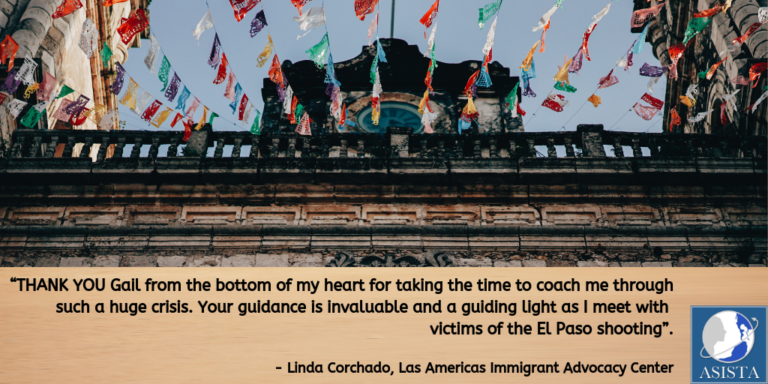
At the request of Las Americas, which is coordinating support for El Paso shooting survivors, ASISTA is helping to bring together mental health, social work, faith-based, local political, and legal communities to work with the hundreds of immigrants harmed in the shooting. For more info on Las Americas work with shooting survivors, click here.
Late last Friday, Immigration and Customs Enforcement (ICE) released a new fact sheet outlining when they will grant “stays” of deportation to crime victims who have cooperated with law enforcement investigations applying for a U visa. This new guidance will create enormous barriers for survivors of violence; it eliminates critical procedural safeguards and will lead to an increased risk that survivors may face deportation before their cases are decided. While ICE has issued a fact sheet on this new policy, it has not yet released the actual policy directive for the public to review. Background: The fact sheet states that ICE has replaced long-standing guidance which laid out the process ICE should follow in adjudicating stays for U visa applicants in removal proceedings and in immigration detention. Specifically, ICE was required to reach out to U.S. Citizenship and Immigration Service (USCIS) to determine whether the applicant has established a “prima facie” case. If they did, then ICE could “favorably view” a victim’s request for a stay of removal (absent certain adverse factors). New changes: The “prima facie” determination process outlined in the prior guidance has been replaced by a “totality of the circumstances” framework, instructing individual ICE officers to consider positive or negative factors and “any federal interest(s) implicated” to decide whether halting deportation is appropriate. ASISTA is deeply concerned that this new standard is vague and will not improve this important process for survivors. Legal obstacles: Federal statute specifically mentions the “prima facie” analysis when considering U visa applicants’ stay requests. [i] ICE cannot simply swap this Congressionally-established prima facie standard for a totality of the circumstances standard. Furthermore, the fact sheet indicates that ICE will no longer have to receive input from those government officials with specialized training in survivor-based cases. Untrained in trauma-informed practice, and in the dynamics of domestic and sexual violence, these agents will determine a survivor’s “totality of the circumstances” as well as what “federal interests will be considered.” This will result in inconsistent adjudications of stay requests, an erosion of due process and limits on access to protections for survivors. It will cause additional hardship, both for the agency and the advocacy community, to address the erratic outcomes of this new guidance. For survivors, the consequences are dire. Survivors fleeing abusive relationships may not have documents available to help support a “totality of the circumstances framework” and the trauma they endured due to their victimization is compounded enormously by the risk of deportation. The fact sheet also contains provisions for victims on the U visa waitlist and those granted U visa status, stating “It is ICE policy to respect USCIS’ grant of deferred action to a U visa waitlisted petitioner.” [ii] Waitlisted victims and approved survivors should not have to endure the hardship and uncertainty of being in removal proceedings. Creating Additional Barriers: ASISTA remains deeply concerned about ICE abandoning its prior guidance. The new policy will increase ICE’s disparate treatment of requests to halt deportation for crime victims cooperating with law enforcement investigations. USCIS currently has an egregious backlog in the adjudication of U visa applications and the processing times for U visa cases is listed to be between 51.5 and 52 months [iii] from the time of filing to consideration on the waitlist. Such long waits, coupled with ICE’s harmful new policy, mean that survivors who cooperate with law enforcement to increase public safety will now risk potential deportation before their cases are ever heard. Deporting immigrant crime victims who have been certified as helpful to law enforcement directly contravenes the purpose of these bipartisan protections established by Congress. We call on ICE to re-establish the prima facie system and to halt deportations of immigrant crime survivors while their applications are pending. We urge Congress to hold the Department of Homeland Security accountable for diminishing access to critical protections for victims of crime.
It is beyond overwhelming to track the myriad ways, large and small, in which DHS’ policy is eroding access to critical immigration protections, including those designed to protect immigrant crime survivors. Sometimes these policy changes don’t grab headlines, but they all contribute to DHS’ calculated and callous plan to weaken existing paths to immigration benefits. Given our mission and expertise, ASISTA is deeply concerned about these policy changes as they often diminish access to immigration protections for survivors of domestic violence, sexual assault and human trafficking.
This Quick Reference Guide and Risk Assessment Worksheet is designed to accompany the longer Practice Advisory on Factors to Weigh When Considering a T visa. It provides a streamlined overview of key considerations and a practical tool for identifying potential risks, benefits, and client-specific concerns during case consultations.
Survivors hoping to earn U- or T-based adjustment of status must generally spend 3 years in U or T status and must be in valid U or T status when they apply to adjust. If a survivor falls out of status, they may be able to regain status by means of a nunc pro tunc extension of status application. This Practice Advisory describes how to submit a nunc pro tunc I-539 extension of status application and contains an annotated sample filing from a successful case. It warns that nunc pro tunc I-539s may not be filed if removal proceedings have commenced against the survivor.

This Practice Alert summarizes USCIS’s new extreme vetting policies, including broad adjudication holds, re-review of previously approved cases, and heightened discretionary scrutiny, and explains their serious implications for immigrant survivors seeking safety and stability. It also provides practical guidance for practitioners on preparing clients for the impact of these measures and on developing case strategies and potential legal challenges.

On January 23, 2026, the federal Trafficking Survivors’ Relief Act of 2026 (TSRA) became law. The TSRA provides a remedy for trafficking survivors to obtain relief from federal criminal records stemming directly from their exploitation. In enacting the TSRA, Congress acknowledged that trafficking survivors frequently acquire a criminal history as a result of their exploitation, which can be a barrier to employment, housing, education, and essential support services and make them more vulnerable to re-exploitation. This 2-pager describes the TSRA and its potential use by immigrant survivors of trafficking charged with or convicted of federal crimes.